Word Document (.docx)
Ready to use legal template
Drafted by experienced lawyers
Indonesian-English translation
Ready to use legal template
Drafted by lawyers
Indonesian-English translation
Home › Business contracts › Supply Agreement
Learn more about Supply Agreement in Indonesia
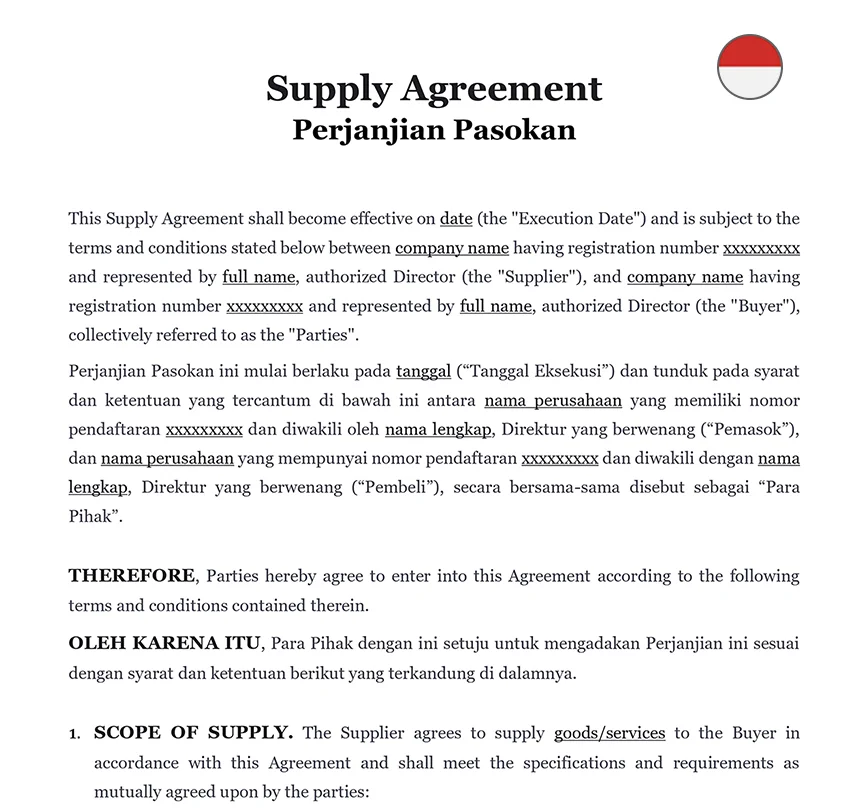
A supply agreement is a key legal contract that sets the terms for buying and selling goods or services between two parties in Indonesia. It’s an essential tool that outlines product details, delivery times, prices, and quality requirements. Themis Partners provides a customizable template, created by legal experts to meet Indonesian regulations, ensuring a smooth and secure supply process. This template is designed to be straightforward and adaptable, making it easy to edit while remaining compliant with local laws. Whether you’re a supplier or a buyer, this document is crucial for clear communication and successful business transactions in Indonesia. For a comprehensive legal framework for various business transactions in Indonesia, Themis Partners also offers a Distribution Agreement and a Service Agreement.
Table of contents
-
What is a Supply Agreement in Indonesia?
-
Why use a Supply Agreement?
-
What should a Supply Agreement include under Indonesian law?
-
What are the key benefits in a business relationship?
-
How does it offer legal protections?
-
What if I don’t have a Supply Agreement?
-
How can a Supply Agreement be terminated in Indonesia?
What is a Supply Agreement in Indonesia?
A supply agreement is a legally binding contract established between a supplier and a buyer to govern the terms and conditions of the supply of goods or services. It outlines the rights and obligations of both parties, ensuring a clear understanding of the expectations and responsibilities involved in the supply relationship. The agreement typically covers key aspects such as the quantity and quality of the products or services, pricing and payment terms, delivery schedules, warranties, Intellectual Property rights, confidentiality, dispute resolution mechanisms, and termination provisions. A well-drafted supply agreement promotes transparency, reduces misunderstandings, and provides a framework for a mutually beneficial business relationship between the supplier and the buyer.
Why use a Supply Agreement?
Using the agreement offers several advantages for both suppliers and buyers.
| ➤ Firstly, it provides a clear understanding of the terms and conditions governing the supply relationship, minimising potential disputes and misunderstandings. |
| ➤ The agreement defines the rights and obligations of each party, ensuring transparency and accountability. |
| ➤ It also helps to establish consistent standards for the quality, quantity, and delivery of goods or services, which promotes reliability and customer satisfaction. |
| ➤ Additionally, a supply agreement can address important aspects such as pricing, payment terms, intellectual property rights, and confidentiality, protecting the interests of both parties. |
| ➤ By formalizing it, the agreement provides a legal framework for resolving conflicts, facilitating efficient dispute resolution. |
ℹ️ Overall, using this agreement offers security, clarity, and stability, fostering a mutually beneficial and successful business partnership.
What should a Supply Agreement include under Indonesian law?
A supply agreement should include the following key elements:
1. Parties
Clearly identify the legal names, addresses, and contact information of the supplier and the buyer.
2. Scope of Supply
Define the goods or services being supplied, including any specifications, quantities, or quality requirements.
3. Pricing and Payment
Outline the agreed-upon price, any applicable taxes or fees, and the payment terms, including due dates and methods of payment.
4. Delivery Terms
Specify the shipping methods, responsibilities for packaging and insurance, and the expected delivery schedules.
5. Quality Control
Address the quality standards, inspection procedures, and any testing or certification requirements.
6. Warranties and Liabilities
Define any warranties provided by the supplier, including limitations of liability and remedies in case of defects or non-compliance.
7. Intellectual Property
Address ownership and protection of intellectual property rights related to the supplied goods or services.
8. Confidentiality
Include provisions to protect confidential information shared between the parties during the supply relationship.
9. Dispute Resolution
Specify the mechanisms for resolving disputes, such as negotiation, mediation, or arbitration.
10. Termination
Outline the conditions and procedures for terminating
What are the key benefits in a business relationship?
A strong business relationship between parties can yield numerous key benefits. When it comes to service agreements, a solid relationship can lead to enhanced communication and collaboration, ensuring that both the service provider and the client are on the same page regarding expectations, deliverables, and timelines. It fosters trust and reliability, as the service provider consistently meets or exceeds the client’s requirements.
A positive business relationship in Service Agreements often results in customer satisfaction, leading to long-term loyalty, repeat business, and positive referrals. Similarly, in distribution agreements, a robust business relationship between the manufacturer or supplier and the distributor can lead to increased market reach, expanded distribution channels, and access to new customer segments. It facilitates effective coordination, timely product delivery, and efficient inventory management. Additionally, a strong business relationship in distribution agreements often includes mutually beneficial terms, such as volume discounts or exclusivity arrangements, which can contribute to the success and growth of both parties involved.
How does it offer legal protections?
The agreement offers legal protections by establishing a clear framework and set of obligations for both the supplier and the buyer.
| ➤ It helps to define the rights, responsibilities, and expectations of each party, reducing the likelihood of misunderstandings and disputes. |
| ➤ By specifying the terms and conditions related to pricing, payment, delivery, quality, and other important aspects of the supply relationship, the agreement provides a legally binding document that can be referred to in case of disagreements or breaches. |
| ➤ It helps to mitigate risks by outlining warranties, liability limitations, and dispute resolution mechanisms. |
| ➤ In the event of non-compliance or breaches of the agreement, the legal provisions within the supply agreement can be invoked to protect the aggrieved party's interests and seek appropriate remedies or compensation. |